The Beginning of a New Practice
In September 2020, after completing a series of textile works, I began to realise that fabric alone could no longer hold everything I wished to express. While textiles remained the foundation of my practice, I felt an increasing need for another visual language—one capable of carrying more direct imagery while preserving the symbolic and philosophical ideas that had always shaped my work.Around this time, a collector introduced me to a Chinese oil painter whose distinctive practice I greatly admired. He generously gave me several used oil paints and worn brushes. Although I had never received any formal training in painting, I asked if he would teach me. He gently refused, saying that my artistic language had already found its own direction and that I did not need to follow another person's path. His words left me without instruction, but also with complete freedom.
Meanwhile, I had become deeply absorbed in studying the “I Ching”,(Book of Changes易经 ). One quiet evening, after reading, a breeze moved through my room and lifted the fine cotton gauze curtains I had dyed with tea. The deep blue night beyond the window merged with the warm light inside, creating a moment of remarkable stillness. Without planning or hesitation, I picked up the old brushes and painted my first self-portrait.In the painting, I look towards the upper left corner, contemplating the invisible movement of Yin and Yang. More than a portrait, it became a record of a question that continues to shape my practice: how can the unseen principles that govern nature, time and existence be made visible through art? This painting marked the beginning of an ongoing body of work. Since then, painting has become another material within my practice—working alongside textiles, thread and found objects—to explore the relationship between philosophy, memory, nature and the hidden structures that connect them.


Solar System
100cm x 100cm, oil on canvas, 2020
The conceptual foundation of this work is rooted in the Chinese philosophy of Yin and Yang and the Five Elements. The colours associated with Wood, Fire, Earth, Metal, and Water—green, red, yellow, white, and black—are used to symbolise the celestial bodies of the solar system: Venus, Mercury, Mars, Jupiter, Saturn, together with the Sun and the Earth.The vibrant, fluid fields of colour evoke the movement of "qi"气 —the vital energy believed to flow through the gravitational forces generated by the motion of celestial bodies. As the planets move in their eternal cycles, colours shift and interact, Yin and Yang alternate, and life continues in an endless rhythm of movement, transformation, and renewal.

Existence
100cm x 120cm, oil on canvas, 2020-2021
The inspiration for Existence is rooted in the Chinese philosophy of Yin and Yang and the Five Elements. The five colours associated with the Five Elements are randomly distributed across the surface, extending and unfolding through the composition. Colours representing opposing forces are then layered upon one another, creating a visual tension between growth and restraint.
One of the conditions of existence lies in the continual alternation between expansion and limitation. Without restraint, endless growth eventually reaches its extreme and turns towards destruction; without growth, restraint alone leads to decline, exhaustion, and ultimately emptiness.
Like life itself, existence is shaped through the interaction of opposing forces. Where Yin and Yang meet, there is movement; where movement exists, there is transformation. It is within this continual balance between growth and restraint that existence takes form.


The Room
40cm x 50cm, oil on board, 2021
The Room is based on two bedrooms I lived in during my childhood, reconstructed from different perspectives and brought together into a single space. Although these rooms belonged to different periods of my life, they remain connected in my memory through a shared sense of darkness, isolation and fear.
When I was four years old, after the death of my great-grandmother, I was moved into her room. Situated at the far end of the house beneath a bamboo grove, the room had no windows and received almost no natural light. It was damp, dark and filled with the traces of everyday rural life: earthen walls, a leaking tiled roof, piles of sweet potatoes and grain, old jars and containers, and various household chemicals. Insects crawled across the floor, walls, beams and roof tiles, scattering suddenly whenever I passed. The only daylight entered through a single translucent roof tile, while an old tungsten bulb provided barely enough light to see the room.
For a child, the physical darkness of the room became inseparable from an inner sense of fear. I was frightened not only by the insects, darkness and the presence of the deceased, but also by the feeling of being placed somewhere I did not understand and had no power to change. Every night, I experienced the same recurring nightmare: countless small black circular forms densely gathered together, violently moving against a grey background. I would wake in fear and find myself still surrounded by the same darkness.
Eventually, I asked my grandmother if I could stop sleeping there, but my fear was not taken seriously. At the age of nine, when my family built a new house, I was finally moved into another bedroom on the second floor. Although it was still a room with very little sunlight, it represented a different kind of space to me. It was not the room I had feared, and I was grateful simply to have left the first one behind. I remained there throughout my adolescence and never returned to either room after becoming an adult.
Through "The Room", I revisit these spaces not as they physically existed, but as they remain within memory. The two bedrooms are fragmented, layered and reassembled from different viewpoints, reflecting the way childhood memories are rarely preserved as complete images. Instead, they survive through fragments of light, darkness, objects, textures, sensations and fear.
The work explores how physical environments can become containers for psychological experience, and how spaces from childhood can continue to exist long after we have physically left them. What appears to be a room is therefore also a reconstruction of an inner landscape—a place where memory, fear, loneliness and the experience of growing up remain permanently intertwined.


The Curtain
50cm x 60cm, oil on canvas, 2021
“The Curtain” was created during a particularly intense and productive period of my artistic practice between 2020 and 2022, when I was often working late into the night and spending long periods immersed in making.
One day, after falling asleep late and waking around midday, I found myself lying between sleep and wakefulness. A lake-green and white curtain beside me was gently moving in the wind. Sunlight passed through a series of star-shaped openings in the fabric, casting shifting patterns of light across the room.
In that half-conscious state, the moving patterns gradually appeared to me as a collection of eyes watching me through the curtain. The sensation was fleeting, but vivid enough to remain with me after I woke.
I painted “The Curtain” immediately afterwards, attempting to preserve not the scene itself, but the strange psychological experience of seeing something familiar transform into something unfamiliar. The work explores the unstable boundary between perception, imagination and reality, and the way an ordinary moment can become strangely charged when consciousness is suspended between dreaming and waking.

Humanity
50cm x 60cm, oil on canvas, 2021
One day in 2021, I found myself looking at my own reflection and wondering: what is the essence of being human?
At the material level, scientists continue to investigate the nature of human existence; at the level of consciousness, philosophers and theologians have explored it for centuries. But when I approach the question through my own experience, I ask myself: what does it mean to be human?
Human beings possess the instincts of animals, yet we also have a remarkable capacity for thought, imagination and creation. We exist within the natural world, while simultaneously seeking to transcend it. At present, perhaps the most profound realm in which we can transcend our physical limitations is consciousness.
Every human existence is extraordinarily complex and cannot truly be reduced to a single definition or category. In attempting to translate this complexity into an image, I loosely imagined four dimensions of human consciousness: transcendence, divinity, growth and humanity.
The colours of the work draw partly from the ancient Indian chakra system. Violet and blue, associated with higher states of energy, represent transcendence and the divine. Grey represents what I imagine as the colour of humanity itself: mixed, complex, unpredictable, and shaped by the chaotic totality of human consciousness.
Life is never simply black or white, nor can it be defined by a fixed label. Different energies and experiences intermingle, eventually forming shades of grey that merge and coexist with their surroundings. The high-energy violet and blue figures close their eyes, absorbed in states of concentration, contemplation, emptiness, or perhaps simply nothing at all. At the centre, the grey figure embodies humanity. With an almost proud expression, it occupies the middle ground, asserting its existence and courageously claiming its own value.
Through this work, I attempt to express the way I perceive humanity: within a single body, countless forms of consciousness—of different intensities and directions—exist simultaneously. Depending on our environment and the people or circumstances we encounter, different aspects of consciousness may take control, producing different ways of responding and, ultimately, different experiences of physical reality.
Human beings are complex, unstable and remarkably adaptable creatures. We are not defined by a single consciousness, but by the constant interaction of many different states of being.


Moon City
40cm x 50cm, oil on board, 2022
Moon City originated from a dream in which I found myself on an unfamiliar planet. The sky and the ground were filled with countless moons, resembling the different phases and forms of the moon as seen from Earth.
Some appeared as complete circles, while others took the forms of half-moons, crescents and other changing shapes. They were scattered throughout the sky and across the ground, creating an unfamiliar landscape entirely composed of moons.
The dream transformed a familiar celestial object into an entire world. In Moon City, I reconstruct this imagined landscape as a space suspended between reality and the subconscious, where scale, space and ordinary perceptions of the natural world are no longer fixed. The moon is no longer something distant in the sky, but becomes the landscape itself—a place that feels both strangely familiar and completely unknown.


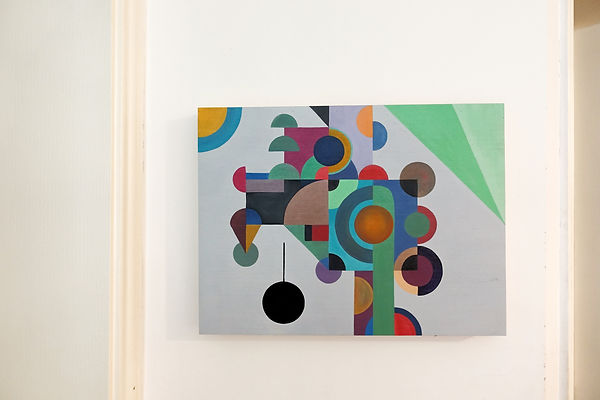
Wu Xing
100cm x 100cm, oil on canvas, 2022

My birthday 1
100cm x 100cm, oil on canvas, 2022

The earth
100cm x 100cm, oil on canvas, 2022


Fruit, Flower, Leaf, Root
“Fruit, Flower, Leaf, Root”was created in 2022 and was inspired by the concept of 【Four Pillars of Destiny (BaZi)】 within the broader philosophical system of Yin-Yang and the Five Elements.In BaZi, every moment is understood to possess a distinct energetic configuration, determined by a specific combination of time and space.
The moment a human being separates from the mother’s body can be imagined as the moment a seed is activated. From that instant onward, each person begins their own unique life cycle, moving through growth, transformation, illness, ageing and ultimately death.
According to BaZi, the precise moment of birth establishes an individual’s unique energetic position within time and space. From this starting point, the course of a life unfolds through a complex and subtle interaction of energies, shaping each person’s distinctive journey.
The four pillars—year, month, day and hour—can also be understood as corresponding broadly to different stages of human life: childhood, youth, adulthood and old age.
I see this progression as analogous to the changing seasons and the life cycle of a plant: from taking root and germinating, to flowering and bearing fruit, and eventually withering and returning to the earth.Through this work, I explore the relationship between “time, destiny and the natural cycles of life”, imagining human existence as part of a larger rhythm of growth and decline, beginning and ending, in which every life is rooted in a particular moment of the universe.


A Dark Decade
90cm x 70cm, oil on cavas, 2023
A Dark Decade depicts my birth date suspended within a field of absolute blackness.
Within the system of Four Pillars of Destiny (BaZi), human life is not only understood through cycles of growth and decline, analogous to the changing seasons and the life cycle of a plant. It is also shaped by different periods of experience, circumstances and challenges that unfold throughout a lifetime.
This work refers to the ten-year period from 2017 to 2027, during which, according to my BaZi chart, I am experiencing a major cycle associated with Qi Sha (Seven Killings). Within BaZi, Qi Sha is traditionally associated with intense pressure, confrontation, adversity and uncompromising external forces. It can represent periods in which an individual is confronted with difficult and sometimes painful experiences arising from family, culture, environment, personal beliefs and their understanding of the world.
I created this work in early 2023, while I was experiencing a profound period of conflict and emotional pain within my family of origin. Looking back, this period became an important turning point in my life. It ultimately contributed to my decision to deepen my commitment to my partner through marriage and, eventually, to leave my previous environment and begin a new life abroad.
The blackness surrounding my birth date represents not simply darkness, but a period of intense confrontation and transformation. It is a space in which the familiar structures of my life were challenged, forcing me to reconsider who I was, what I valued, and where I wanted my life to go.
Rather than representing darkness as an absolute negative, the work reflects how a difficult period can become a threshold between one life and another. The decade of darkness became, in retrospect, the beginning of a different kind of life.


A lifetime
120cm x 100 cm, Oil on canvas, 2022
This work translates my birth date and time into a visual composition using the symbolic system of the Heavenly Stems and Earthly Branches, where colours and geometric forms correspond to the principles of Yin–Yang and the Five Elements in traditional Chinese cosmology. Surrounding the central composition are the cyclical fortune periods and annual cycles associated with my life, spanning from my birth in 1990 to 2087. Rather than serving as a prediction of the future, the work presents an artistic interpretation of an ancient philosophical framework, transforming an invisible system of time, rhythm and interconnectedness into a visual language. It explores how cosmological thought can shape personal identity while inviting dialogue between Eastern philosophy and contemporary visual art.


